
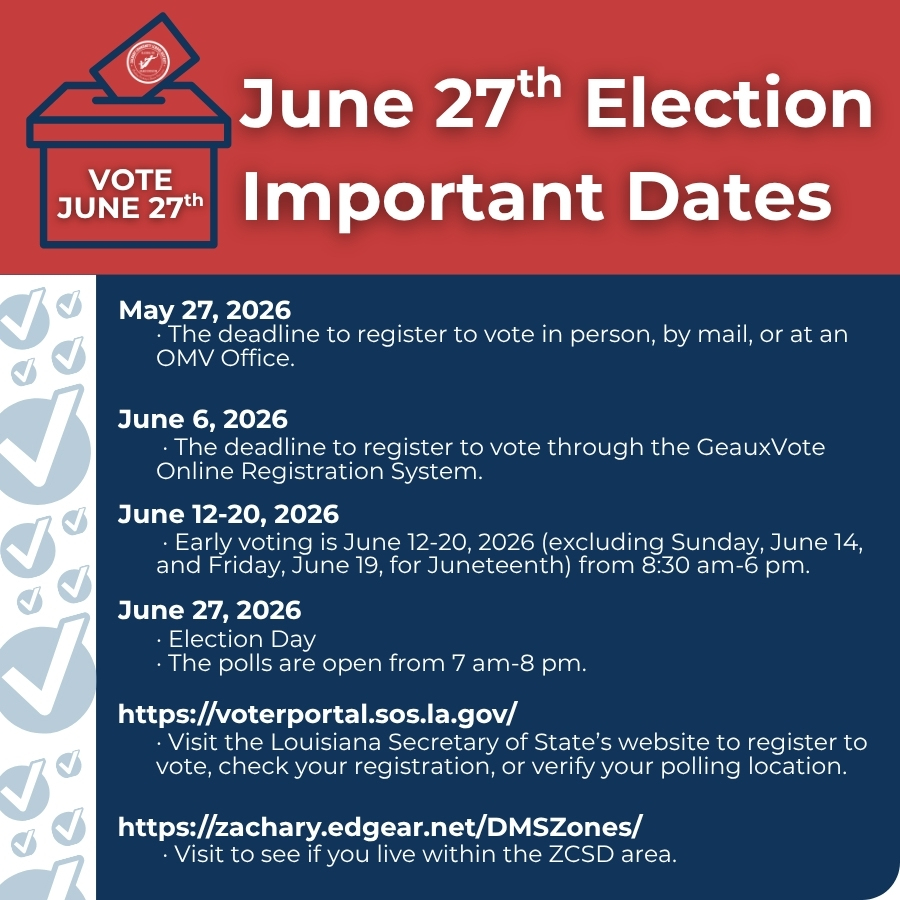
ELECTION DAY IS SATURDAY, JUNE 27th!
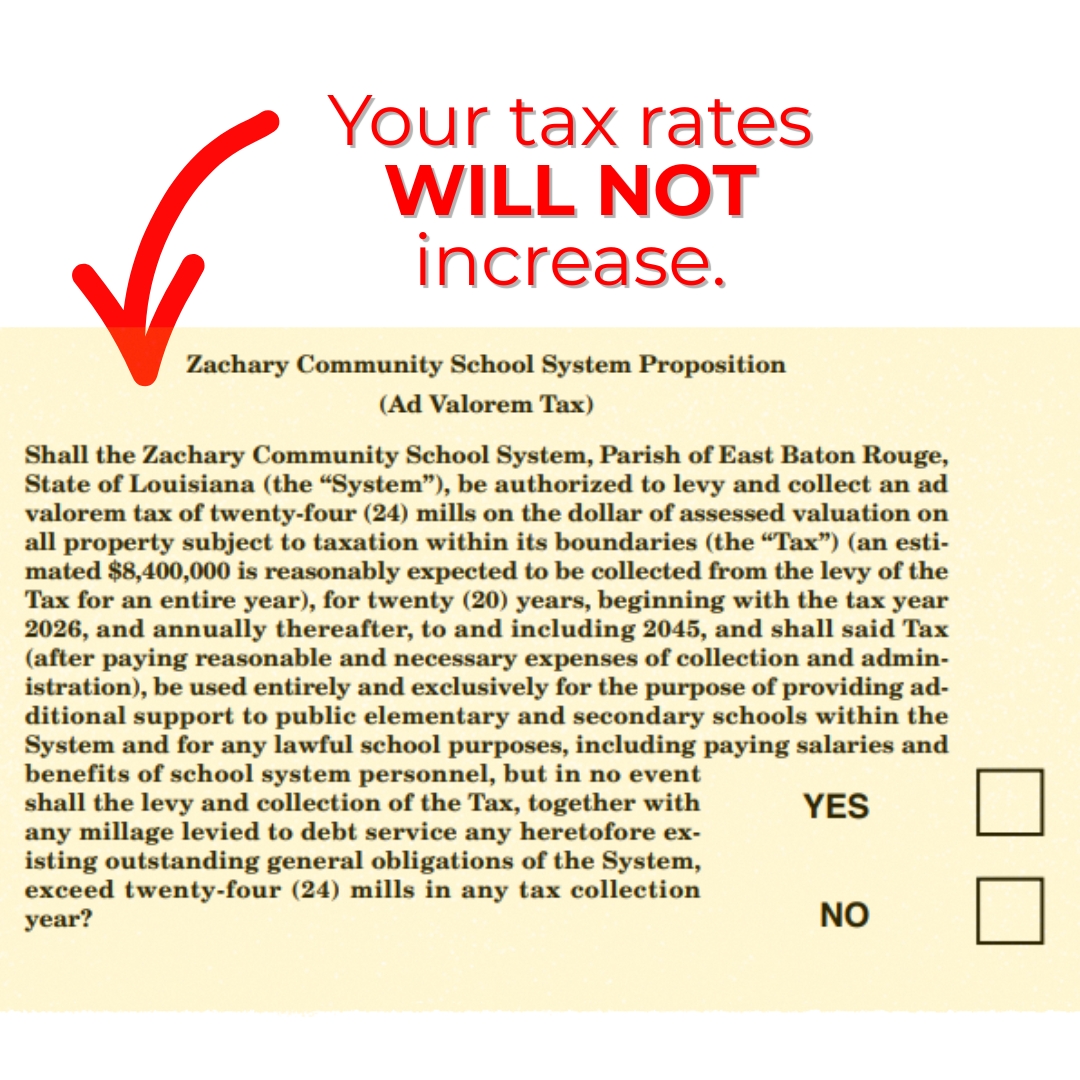
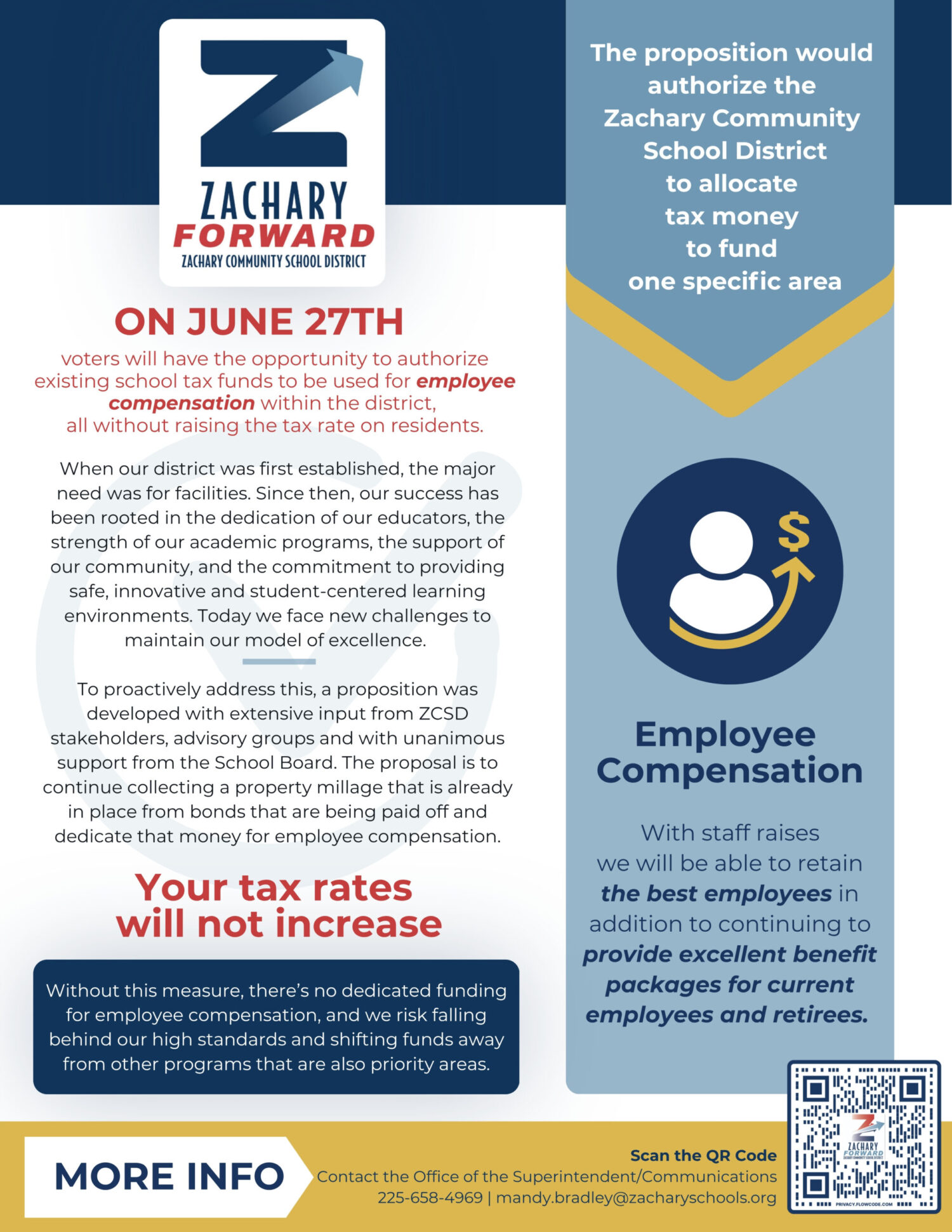
ZCSD has placed a proposition on the ballot for June 27, 2026, to authorize the district to redirect existing school bond taxes toward employee compensation, without raising the current tax rate on residents.
June 27, 2026 Ballot
The initiative was developed after extensive ZCSD stakeholder input and strategic planning. Stakeholder advisory groups identified employee compensation for recruiting and retaining our talented employees as a top priority for the district. The School Board voted unanimously to place the measure on the ballot, reflecting broad support for the plan.
The proposal would authorize the ZCSD to reallocate millage from bonds as they are being paid off to fund employee compensation increases.
By reallocating the taxes residents are already paying, over time, the ZCSD can significantly raise employee salaries and continue providing excellent benefit packages for current employees and retirees of the district.
The “Zachary Forward” initiative comes as ZCSD’s previous school construction bonds, funded by an initial 36-mill property tax, near maturity. If approved by voters, the measure would maintain the millage rate at a decreased 24 mills and dedicate it to employee compensation now and in the future.
What is meant by “Employee Compensation”? Enabling more competitive salaries and benefits to recruit and retain quality educators (neighboring districts have implemented raises, and ZCSD aims to be more competitive).
The tax language ensures that this is not a tax increase, but a rededication of an existing tax. This reallocation will not increase millages past the current rate.
If you have any questions, contact the Office of the Superintendent/Communications (225-658-4969 or mandy.bradley@zacharyschools.org).
Strategic Plan Connection
(linked above)
To maintain this standard and prepare for the future, the district has developed a Strategic Funding Plan tied directly to our Board approved 2025-2030 Strategic Plan (linked on our website) and the proposed dedicated tax measure. This plan outlines how voter-approved revenues will be allocated to strengthen our workforce while protecting the programs that define our holistic student-centered approach by supporting the Three A’s (Academics, Arts, and Athletics).
The priorities in this plan reflect our core belief that investing in people and resources is investing in student success. Each priority is designed to address current challenges, anticipate future needs, and ensure fiscal accountability to the taxpayers of Zachary.
FREQUENTLY ASKED QUESTIONS
Yes, it is “new” because we are asking for funds to be dedicated in a new way, but your tax millage rates will not increase beyond the current millages you will pay this year. This is NOT an increase in the tax rate. The proposal is to continue collecting property millage that is already in place from bonds that are being paid off and use that money for other needs in the school district.
In short, you will pay the same property tax rate you pay now. But instead of money rolling off after the bonds are paid each year, any leftover funds will go into employee compensation.
A millage is a property tax based on property’s assessed value. Your home’s assessed value is 10% of its estimated property value, as determined by the parish assessor’s office. One mill is 1/1000 of a dollar, so a millage rate is the number of dollars you pay for every $1,000 of your property’s assessed value. In Louisiana, most homeowners have a homestead exemption on their property which reduces the impact of millages. If you have a home valued at $250,000, the millage applies only to the portion that is not exempted. This means the millage would be applied on $175,000 instead of $250,000. To calculate your millage tax, divide your property’s assessed value (without the exempt amount) by 1,000 and multiply that by the millage rate. A home valued at $250,000 with a homestead exemption would start this math at $17,500; dividing that by 1,000 = $17.5 and multiplying that by 24 mills (based on last year’s millage rate) = $420 a year.
When our district was first established, the major need was for facilities. Since then, our success has been rooted in the dedication of our educators, the strength of our academic programs, the support of our community, and the commitment to providing safe, innovative and student-centered learning environments. Today we face new challenges to maintain our model of excellence.
To proactively address this, a proposition was developed with extensive input from ZCSD stakeholders, advisory groups and with unanimous support from the School Board. The proposal is to continue collecting a property millage that is already in place from bonds that are being paid off and dedicate that money for employee compensation.
The tax election in June 2026 will ask for a 20-year term, but the School Board is able to lower the millage rates each year as needed. After those 20 years, the public would need to vote again on the proposal if it is needed.
Yes. Since 2003, the School Board has adjusted the millage rates down overall to 85% of the original millage rates. In 2003, Zachary Community School District residents had millage rates of 79.2 mills assessed for schools; in 2025, millage rates are at 67.2 overall. The 24-mill proposition is part of those 67.2 mills.
The ballot will have a proposition explaining the rededication of 24 mills (based on last year’s millage rates) for the stated purpose of employee compensation. It will mention the duration of the rededication and that it does not increase the millage rate. The wording can be a bit technical, which is required by law. The ballot will phrase the proposition as a question, essentially asking if you support allowing the school board to use the existing mills for the purposes of employee compensation.
Voting “yes” means you agree to this proposed way of adjusting tax dollars so the community can provide additional support to the school district. Voting “no” means you do not want to give more money to the school district.
We will provide a sample ballot on our website when it becomes available.
If the measure fails, the current bond tax will expire as the bonds are paid off, which should be eight years from now. Taxpayers will eventually see a decrease in their property tax rate. However, the school district will lose future funding that would have to be cut or found elsewhere. The likely result is:
- School staff will receive very minimal or no raises at all. The impact of that will make it significantly harder to recruit and retain the best staff, resulting in a possible decline in the quality of education and extracurricular activities for our students. Additionally, staff benefits will likely also be reduced.
In short, saying “no” would provide a tax break in a few years at the potential cost of educational quality and potentially higher costs later).
If approved, the existing bond millage could continue without dropping off, and those tax proceeds would start going into a special fund for employee compensation, starting with next year’s property taxes. The district would then implement plans to distribute that funding to enact salary increases (likely in phases or effective on a certain date). The community would see the impact in the form of improved employee morale and recruitment, and retention of high-quality employees. The benefits would be seen/felt immediately with more competitive pay. Essentially, it secures stable funding for these areas moving forward.
The proposal keeps the tax rate at the current level or lower. The School Board would have the flexibility to roll millages back if additional funding were available in the future. For example, if a large industry moved to our area and substantial new taxes were realized, the School Board could reduce millage usage and provide taxpayers with a lower rate.
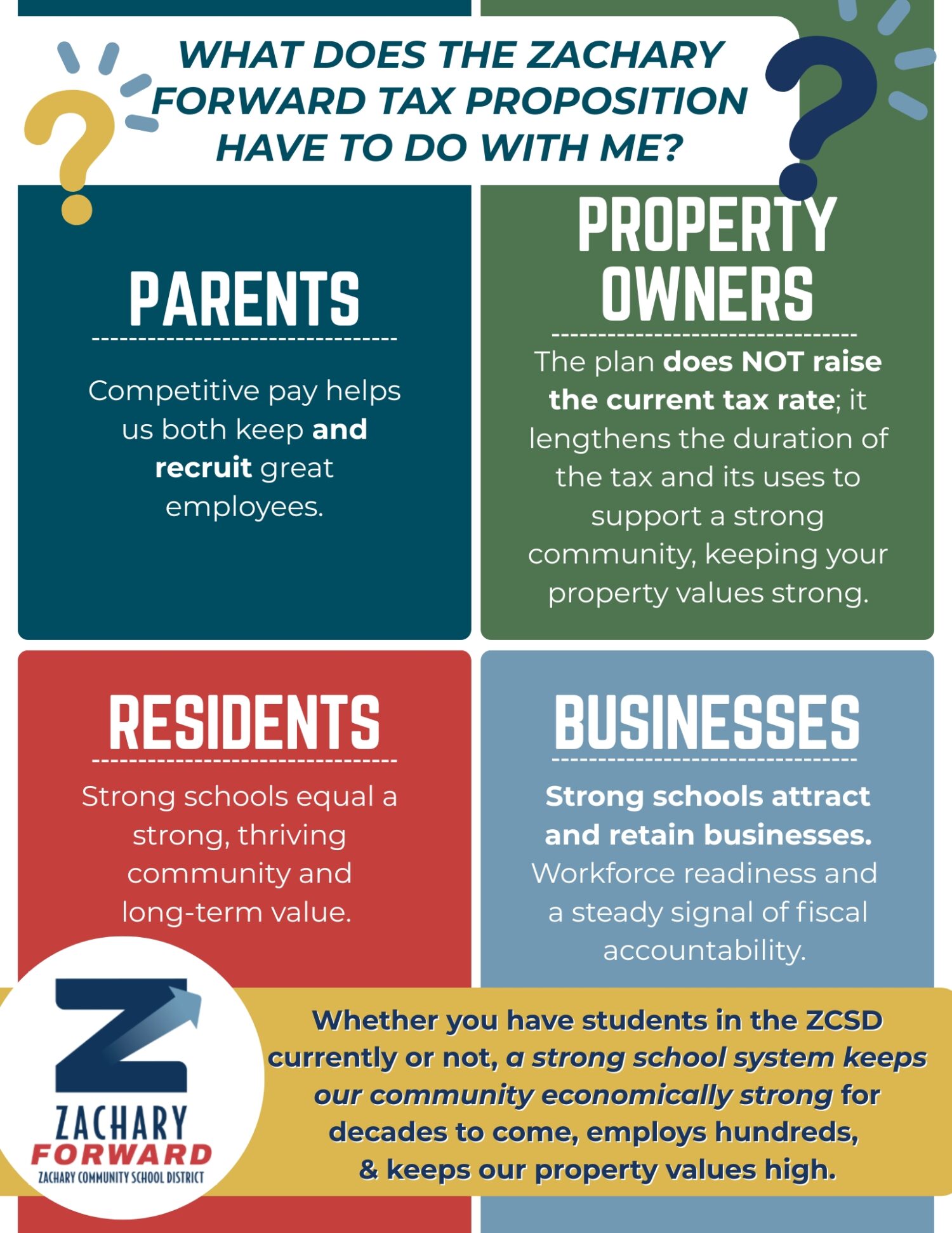
Good schools benefit everyone in the community, not just those with children. Quality schools keep property values high, attract families and businesses to the area, and produce educated graduates who contribute positively to the community. Also, since this measure doesn’t raise taxes, it maintains community assets (schools and an educated workforce) with no extra cost.
Voting “yes” is an investment in Zachary. If the schools decline, it will negatively impact the whole city. The health and progress of our whole community is at stake.
The ballot measure legally restricts the funds to the purpose of employee compensation. By law, the school district must account for those funds and use them only for those categories. Additionally, the School Board participates in yearly audits that provide external transparency on the use of public funds. In addition, the board approved a detailed priority plan to guide the use of the funds at their September 2025 board meeting pending passage of the tax initiative. Click this link to view the plan: Click this link to view the plan
The community can also see results with announced pay raises and continued employment of quality educators. ZCSD has a proven track record of responsible financial stewardship. Voters can trust that the funds will go exactly where they are promised.
The district’s budget is already lean, directed mostly toward basic operations and instruction. Teacher salaries are currently funded through state allocations and existing local taxes, but those sources are not keeping pace with rising costs and competitive pay levels. The stakeholder advisory groups looked at options and strongly recommended this approach as without this rededicated tax, the district would likely have to either go without this compensation or come back in a few years asking for additional funds. The reallocation is the prudent path that avoids cuts, and a bigger tax ask later.
Zachary has a tradition of providing students with opportunities in academics, arts, and athletics, and has worked hard NOT to make cuts in these areas, as many other districts have. ZCSD knows the importance of these programs to our families, as well as the community’s tremendous support and belief in these programs. Excellence in these areas has made Zachary a fantastic place to receive an education. However, many of these programs are seen as supplemental and could be cut in the measure fails to offset raising cost, maintain benefit packages, or provide minimal compensation increases.
The ZCSD recently conducted a five-year demographic study (2025-2030) to assess the population impacts on the ZCSD. The study concluded that the student population of the ZCSD will remain steady and only deviate by about 100-150 students in the next five years. Potential overcrowding is not a concern at this time.
Our district maintains athletic facilities and pays the salaries of our coaches. All other resources come from fundraising, sponsorship, and income from ticket sales that athletic teams use to support their needs. Actually, we are one of only a few districts that don’t support athletics at the district level.
The following information is based off of last year’s millage rates.
A. This tax is already being paid by property owners at 27 mills. In the next year, the tax rate will actually decrease from 27 mills to 24 mills (based on last year’s millage rates). If the voters agree to the reallocation of mills, the tax rate for these millages will stay at 24 mills and not go higher, with the potential of going down in the future. Your property millages will be less next year! For example, if your assessed home value is $250,000, then the cost of the 24 dedicated mills is maintained at the rate of approximately $420 per year or $35 per month. (Reducing debt service from 27 mills to 24 mills is a savings of $53 for a home valued at $250,000 or $98 for a $400,000 home.)
B. If your assessed home value is $400,000, then the cost of the 24 dedicated mills is $780 per year or $65 per month.
C. The board can elect each year to roll back millages not needed that year, so your property taxes could potentially go down if other funding sources are realized.
Your total millages would not go higher than 67.20 total mills, but your home’s assessed value could increase, which would cause a taxpayer to pay more $$$. This is ONLY done by the assessor.